
Underground Utility Construction, Explained
How underground utility construction works: the steps, open trench vs. trenchless methods, undergrounding power lines, safety, and what goes wrong.

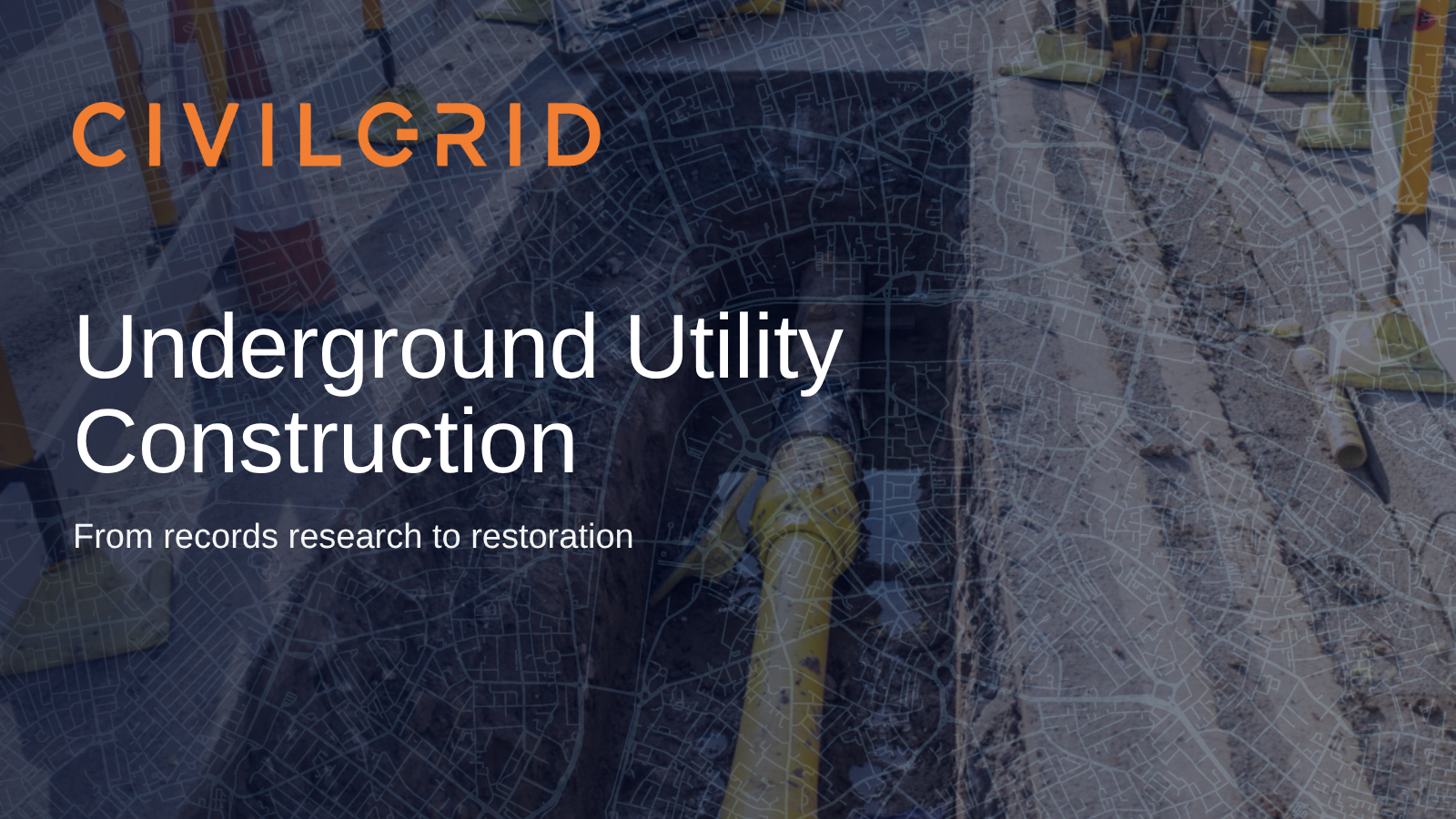
A new water main, fiber line, or buried power line starts as a clean line on a plan. Then it has to fit into ground that's already full: decades of pipes, ducts, encasements, and abandoned lines, many of them poorly documented. Underground utility construction is the work of getting that new line in safely, on schedule, and without hitting what's already there.
This guide covers what underground utility construction involves, how a project moves from plan to restoration, the main construction methods, and where projects most often go wrong.
What is underground utility construction?
Underground utility construction is the installation, replacement, or relocation of pipes, conduit, and cable below ground. It covers new service, like a fiber build or a new subdivision's water lines. It also covers replacing aging infrastructure, relocating lines that conflict with a road or transit project, and moving overhead power lines underground.
The work usually involves several parties: the utility or agency that owns the line, the engineers who design it, the contractors who build it, and the cities and agencies that permit it.
Types of underground utilities
Most underground construction involves one or more of these systems:
- Water: distribution mains, service lines, and hydrants
- Sewer: gravity and pressure sewer mains and laterals
- Storm drain: pipes, culverts, and box structures that carry runoff
- Gas: distribution and transmission pipelines
- Electric: duct banks, conduit, vaults, and direct-buried cable
- Telecom and fiber: conduit and cable for phone, cable TV, and broadband
Each system has its own owner standards for materials, depth, bedding, backfill, and testing. Pressure pipelines, for example, are typically pressure tested before they go into service, and some agencies set their own test requirements. These details vary widely by owner and jurisdiction, so the project's specifications always govern.
The underground utility construction process, step by step
Most projects follow some version of this sequence:
- Planning and scoping. Define the need, the route, the budget, and the schedule. See our guide to project scoping for how to do this well.
- Site investigation. Gather utility records, commission a utility survey, and collect other site data. Records should cover more than location. Knowing how existing lines were built, such as whether a storm drain sits on a bed of coarse rock, helps contractors plan the work. Geotechnical investigation is most important for new installations and deep excavations.
- Design and conflict resolution. Set the alignment and depth, and resolve conflicts with existing lines on paper. That can mean adjusting the design, relocating another owner's line, or planning test holes to confirm critical crossings.
- Permits, traffic control, and 811. Secure encroachment and excavation permits, prepare a traffic control plan, and submit an 811 locate request before digging. Who can sign a traffic control plan varies by jurisdiction. Some accept a civil engineer's stamp, while others require a licensed traffic engineer for more complex work.
- Method selection. Choose open trench, trenchless, or a mix, based on depth, soil, surface conditions, and what's already in the ground.
- Installation. Excavate or bore, install and connect the new line, and test it to the owner's requirements.
- Restoration and as-builts. Backfill, compact, and restore the surface to permit standards. Then record exactly what was built and where, so the next project starts with accurate records.
Open trench vs. trenchless construction
The two main ways to install underground utilities are open trench and trenchless construction. Most projects use some of each.
Open trench construction
Open trench construction is the traditional method: dig a trench, install the line, backfill, and restore the surface. It gives crews direct access and is often the most economical choice for shallow work in open areas. It's also the most disruptive, with lane closures, pavement cuts, and restoration costs.
Under OSHA's trenching rules, trenches 5 feet deep or more require a protective system, such as sloping, shoring, or a trench box, unless they're entirely in stable rock. Trenches 20 feet or deeper need a protective system designed by a registered professional engineer. Shallower trenches aren't automatically safe. In loose, sandy soils, a trench can cave almost immediately, so it may need shoring well before it reaches 5 feet.
Trenchless construction
Trenchless construction installs or replaces pipe with little or no surface excavation, usually working from launch and receiving pits. Caltrans' trenchless construction guide describes the main methods:
- Horizontal directional drilling (HDD): a steerable drill bores a pilot hole, reamers enlarge it, and the new pipe is pulled back through.
- Auger boring: a rotating auger in a drive pit removes soil while steel casing is pushed in behind it.
- Pipe ramming: a pneumatic hammer drives an open-ended steel casing through the ground.
- Microtunneling: a remotely guided boring machine advances from a launch shaft while jacks push the pipe in behind it.
For replacing old lines, the EPA's pipe bursting fact sheet describes pipe bursting: a bursting head breaks the existing pipe apart and pulls the new pipe in behind it.
Trenchless methods avoid most surface disruption, which helps under highways, railroads, waterways, and busy streets. They also carry their own risks. A bore can't see what's in its path, so accurate information about existing utilities matters even more.
Undergrounding overhead power lines
Utility undergrounding means moving overhead power lines, and often telecom lines, into underground duct banks and vaults. Utilities and cities pursue it for several reasons:
- Wildfire risk: buried lines can't be knocked down or spark in high winds.
- Reliability: underground lines are less exposed to storms, falling trees, and vehicle strikes.
- Beautification: removing poles and wires clears views and sidewalks.
Undergrounding is a long process. In San Diego's Utilities Undergrounding Program, design takes 18 to 24 months, underground construction 18 to 36 months, and the final public improvements, like curb ramps, streetlights, and paving, another 12 to 18 months.
For residents, the visible phases are trenching and conduit installation along the street, new equipment like transformers and pedestals, connection of each home's service, and finally removal of the poles and overhead wires.
Safety on underground construction sites
Underground utility construction combines two serious hazards: trench collapse and striking an existing utility. The basics:
- Call 811 before every excavation. Wait for marks, and respect the tolerance zone around them.
- Expose lines before digging close to them. Use hand digging or vacuum excavation to confirm location and depth.
- Protect the trench. Use protective systems as soil and depth require, and keep spoils and equipment at least 2 feet from the edge.
- Inspect daily. OSHA requires a competent person to inspect trenches daily and as conditions change.
- Plan traffic control. Work in or near the road needs a traffic control plan. The plan should spell out how workers in an open trench are protected from traffic, from cones and channelizers for short-term work to concrete barriers where traffic is fast or close.
For more on preventing strikes, see our guide to utility damage prevention.
Where underground construction projects go wrong
Most problems on underground utility projects trace back to information that arrived too late:
- Unknown substructures. The conflict isn't always the pipe itself. A concrete encasement around a duct bank, or a reinforced pad poured over a shallow line, can be far more expensive to work around than the utility it protects.
- Existing lines found late. Lines missing from records, or not where the records say, mean redesign and change orders.
- Paving moratoria. A street that was recently repaved may be off-limits, or require full-width repaving if it's cut.
- Permit conditions and delays. Backfill, restoration, traffic control, and work-hour rules can change the cost and schedule, and they're sometimes not known until the permit is issued.
- Missing or inaccurate as-builts. When last time's work wasn't recorded well, every future project pays for it.
Almost all of these can be found before construction starts, if the research happens early enough.
How CivilGrid helps
Most of the information that derails underground construction already exists. It's just scattered across dozens of utility owners, cities, and agencies.
CivilGrid sources utility maps and as-builts directly from the utilities, municipalities, and agencies that own them, with chain of custody documentation for every record. Teams see that data on one map alongside land rights and potential conflicts, such as paving moratoria, planned paving, and capital projects, before design is locked.
In the field, the free CivilGrid mobile app puts that map on site, logs test hole findings with location-pinned photos and notes, and works offline.
CivilGrid cuts research time, reduces rework and dig-ins, and helps teams scope accurately before committing work. It doesn't replace 811, SUE, or field verification. It gives them a better starting point.
Underground utility construction FAQ
How deep are underground utilities buried?
It varies by utility type, owner standard, and local code. Telecom and electric lines are often relatively shallow, while gravity sewers can be much deeper because they depend on slope. Never assume a depth. Confirm it with records, a utility survey, and test holes.
How long does underground utility construction take?
It depends on the project's length, method, and permitting. A short service installation can take days. Large programs take years: San Diego's undergrounding projects typically take 18 to 36 months of construction after 18 to 24 months of design.
Is trenchless cheaper than open trench?
Not always. Trenchless methods have higher equipment and setup costs but avoid most surface restoration, traffic disruption, and pavement cuts. Under busy roads, railroads, and waterways, trenchless is often the lower total cost. In open, shallow conditions, open trench usually wins.
Who pays for undergrounding power lines?
It depends on the program. Funding can come from utility rates, city funds, special assessment districts, or developers, and many programs use a mix. Check with your city or utility for how a specific project is funded.
Plan your next underground project with better data
The best time to find conflicts is before the first trench is cut. See how CivilGrid works, or read What Is a Utility Survey? and browse our preconstruction glossary.
The short version
- Underground utility construction is installing, replacing, or relocating pipes, conduit, and cable below ground, from planning through restoration and as-builts.
- Crews choose between open trench and trenchless methods like horizontal directional drilling, based on depth, soil, surface conditions, and what's already in the ground.
- Most costly surprises, like unknown substructures, paving moratoria, and permit conditions, can be found before the first trench is cut.
Ready to see what bad data was hiding?
